
Friday, May 4, 2018


Sunday, November 12, 2017
Holiday Special Orders
New for this year, we have smoked hams and loin roasts! These will be produced from our own pasture raised Heritage breed pigs. Because these take several weeks to produce, we are only taking orders through Sunday, December 3rd for Holiday items.
We also have regular, not smoked bone-in and boneless roasts, leg of lamb, rack of lamb, whole duck and whole goose.
To place an order, please go to the
Order Pork
Order Lamb
Order Duck and Goose pages.

Monday, July 17, 2017
Renewed Focus

I am scaling down some parts of the farm and scaling up others. I will continue to raise Heritage pigs and offer breeding stock, feeder pigs and gourmet quality pasture raised pork.
I will now be delivering pork locally as well as shipping direct to your door in the Eastern US. See our Ordering Page for pricing and information.
Providing excellent quality food to people is one of my greatest passions. Hearing someone say how much they enjoy your food is one of the biggest compliments that I can receive. Eat well!
Wednesday, August 20, 2014
Making Magic

Every animal deserves a good farmer, a good butcher and a good chef.
The hand and knife belong to James Naquin-chef, butcher, caterer, friend-a food rock star among chefs and butchers and all things meat. The beautifully marbled cut of meat belonged to a carefully raised Duroc/Hampshire pig. The setting is our farm kitchen. And when all of these elements come together, I can promise you, magic happens.

The very best food, with the very best flavors, cannot be rushed. Good food starts with the soil. Rich soil produces nutrient dense food-grass for the animals, fruits and vegetables for us. Our pig breeds are selected for their hardiness, grazing abilities and exceptional flavor. A sow carries her piglets for 115 days- three months, three weeks, three days.

Once the sows farrows, the pigs are raised on grass in family groups. They are fed whey from a local goat dairy that is leftover from cheese making plus pasture and hay, extra milk from our goats and barley. We don't just feed them the cheapest feed we can find. We feed them the best feeds that produce healthy animals and flavorful meat. The baby pigs come out onto the pasture the day that they are born. They only pick at the grass when they are small, but pasture will make up more and more of their diet as they grow.

We raise Heritage breeds of pigs like Gloucestershire Old Spots, Herefords and Kune Kunes that are known for the exceptional flavor of their pork as well as for being able to turn grass into meat and fat. The flavor of meat is developed through a combination of genetics, feed and time. Cheap, poor quality feeds and fast growth produces pale, tasteless meat. Our Heritage pigs take from 10 months to over a year to grow out, but the taste is worth the wait.

I love the saying above and everything that it encompasses-humane farming, a carefully butchered animal and thoughtful preperation (and this is another local rock star-Ross Flynn). Ah, and this is where the magic happens. When you take that carefully grown animal to an artisan butcher and they handle the meat and cuts with as much care as you put into growing the animal. We have turned the words " butcher and butchering" into something negative in this country. Believe me, when you see this old art performed the right way, it is nothing short of amazing.

Then an equally thoughtful and talented chef, takes that meat and creates a dish that is enjoyed slowly, shared, written about, photographed and shared again. Every piece of the pig is used, not just the tenderloin or the other prime cuts. Smoky pork shanks in a rich broth with greens, melt in your mouth charcuterie spread across a crusty chunk of bread, Jambalaya, with all of its layers of flavor, simmering in a huge cast iron pot on the stove-now you are getting the picture! Friends farmers, chefs and butchers coming together in every step of the process over a shared love of exceptional food, animals, farming, drink and community-now that is truly magic and the very, very best part of this old profession of farming for me.
 |
| Pork shanks over polenta with tomatoes and lemon zest |
Sunday, January 19, 2014
New Year, New Life
The best days on the farm are "new baby days". Warm, sunny days when you walk out to check the animals and find a cow licking her new calf, a wet lamb struggling to stand and nurse or a sow having pigs. You feel blessed to be a part of such a rich life.
Most people do not think of January as warm and sunny, but we have had several nice January days with today being another one. The new babies have a much easier go of it when they are lucky enough to be born on a warm day.


Most people do not think of January as warm and sunny, but we have had several nice January days with today being another one. The new babies have a much easier go of it when they are lucky enough to be born on a warm day.
Rosie, a Gloucestershire Old Spot gilt, had her pigs in a sunbeam in the doorway of the barn. She is a young, first time mom and just had four pigs. The next time she farrows, she will probably have eight or more and the bigger she gets, the more pigs she will have in each litter. She is being a good mom and all four pigs have survived and are thriving.
Pandora, an American Guinea Hog, had her pigs in another barn, out of the wind, in a big pile of straw. While being a good mom is mostly instinct, the ability to care for offspring does not always come to every animal.
Pandora had her first litter in a puddle after breaking out of her farrowing pen. Needless to say, none survived. Her second litter, she had out in the woods (after yet another breakout) and came back with only one surviving pig. She immediately pawned her one offspring off on another mom and went about the business of getting bred again to a boar that was on the other side of the farm. At this point, my faith in her mothering abilities was pretty non existent. Pandora was looking like a good candidate for sausage. The time came for the trip to the processor and I could tell that she was starting to get milk. A look at the calendar and spreadsheets told me that she had to have gotten bred immediately after dropping her second litter. Bad little piggy. So she was spared and locked in a pen that would hold a buffalo=or so I thought. After a week or so in that enclosure, she started to tear things up. In frustration, I let her out and back into the pasture, figuring that I would never see this litter either.
The next morning, on a rainy Saturday, complete with thunder and lightening, she had made a nest in the old barn. She popped out seven black pigs and was the model pig mom, lying down carefully and grunting softly to them while they nursed. She runs to the feed trough , eats, and runs back to her babies. She takes them out to sun bathe when it is cold under the eves of the barn. I swear she smiles and winks at me when I go down to check on her and the babies. She knows that she is not going anywhere now.
Friday, January 6, 2012
A New Year,a Renewed Focus on Great Food

OK, I will admit it, 2011 was rough. More then once, I came very close to selling off all of the livestock, letting the grass grow over the garden and calling it quits. Really. I was frustrated and depressed about the future of small farming and of my small farm in particular.
I was talking about quitting to my hay man, a dairy farmer around the corner from me, and he said, "But what would you do?" I gave him a laundry list of all of the various positions that I had held over the years and he just looked at me and repeated his question. Then I knew what he meant. What would I do NOW, in this economy? Would it be meaningful or just a job? And would it make one iota of difference in a world that needs people who want to make a difference?

Luckily, I am stubborn and I do not give up easily and I REALLY believe in what I am doing. I believe that our systems of farming have to change in order for us to have safe, nutritious, humanely raised food. I believe that we need to leave the land better then we found it and not poison it and use up every bit of resources that it has to offer. I believe that animals harvested for food should be treated with respect and reverence for what they provide us. I also believe that we need to teach others how to farm this way so that good farming practices don't die again. We need to bring our communities back together and start helping one another again as neighbors like we used to do before people started coming home and shutting out the world around them.


Tuesday, November 15, 2011
Transparency-First Annual Farm Day
This past Saturday was our first annual Farm Day and we had a blast. I really enjoyed seeing our farmer's market friends strolling down the drive and interacting with the animals. I told everyone to make themselves at home and to feel free to wander around the farm. Some people took me up on the invitation and took strolls down through the pastures, and out to the back of the farm. We had made-to-order gorgeous fall weather-a bright sunny day and warm temperatures. I had corraled the animals up near the house so that the kids could get a better look at them.
We strolled out into the pastures to see the horses and got mobbed by Jasmine, my old, twenty something donkey and Gertrude-wide and waddling ,as she is close to foaling, and stealing as much of the attention as she could.
I watched as my 30 year old Morgan horse, Cody, walked up to a little girl who barely came to his chest, stopped a respectful distance away and gently lowered his nose to her hand to be touched.
Heritage turkeys and geese strolled through the fallen leaves and we talked about the importance of raising animals naturally and in a clean and healthy environment.
One boy looked at the turkeys pecking through the grass and leaves and commented on how clean they were and how bright and shiny. Rufus, the mini pig, was a big hit as always although he had to go into "time out" a few times for stealing sweet potatoes out of the farm store boxes!
When the last person had trailed down the drive, and Rufus had drug himself happy and stuffed (full of sweet potatoes and apples) into his straw bed, I started to reflect on what had happened that day and how I felt about it. I enjoyed sharing my farm with my friends/customers (one and the same!). The questions and conversations were stimulating and thought provoking. We talked about how raising healthy, happy animals equated to healthy, nutritous and clean food. I enjoyed the fellowship and the conversation immensely, but most of all it was about transparency. Opening up the farm let people see, in person, the things that I talk about at the markets week after week-turkeys raised on grass, the goats that produce the milk for the soaps and lotions, a laying hen coop on wheels, empty, because the hens were all outside, busily scratching for bugs in the woods and on the lawn.
Lack of transparancy is finally catching up with our conventional food system. Pigs are hidden behind concrete walls, turkeys are housed 5,000 to a building with "bio-hazard" and "No tresspassing" signs at the road, beef cattle stand in stockyards up to their knees in manure, safe from the eyes of the public. No people allowed, no cameras, NO TRESSPASSING-because you would not buy their products if you saw how these animals were really treated and raised. Transparency is important as we try and change our food systems.
In the spring, perhaps around the end of May, I'll have another open Farm Day and I hope that you can make it. See how your food is grown, connect with your community and join in on the conversation-it's important for all of us.
 |
| Addison Reddick and Lance & Ellye Sawyer pet a pregnant Gertrude |
 |
| Minerva Jane-one of the dairy goats |
 |
| Gertrude the (very wide) guard donkey! |
I watched as my 30 year old Morgan horse, Cody, walked up to a little girl who barely came to his chest, stopped a respectful distance away and gently lowered his nose to her hand to be touched.
 |
| Cody |
Heritage turkeys and geese strolled through the fallen leaves and we talked about the importance of raising animals naturally and in a clean and healthy environment.
 |
| Heritage Bourbon Red turkeys graze in the fall sunshine |
One boy looked at the turkeys pecking through the grass and leaves and commented on how clean they were and how bright and shiny. Rufus, the mini pig, was a big hit as always although he had to go into "time out" a few times for stealing sweet potatoes out of the farm store boxes!
 |
| Rufus finishing off the Gala apples |
When the last person had trailed down the drive, and Rufus had drug himself happy and stuffed (full of sweet potatoes and apples) into his straw bed, I started to reflect on what had happened that day and how I felt about it. I enjoyed sharing my farm with my friends/customers (one and the same!). The questions and conversations were stimulating and thought provoking. We talked about how raising healthy, happy animals equated to healthy, nutritous and clean food. I enjoyed the fellowship and the conversation immensely, but most of all it was about transparency. Opening up the farm let people see, in person, the things that I talk about at the markets week after week-turkeys raised on grass, the goats that produce the milk for the soaps and lotions, a laying hen coop on wheels, empty, because the hens were all outside, busily scratching for bugs in the woods and on the lawn.
 |
| Heritage hens graze and scratch on the back lawn |
Lack of transparancy is finally catching up with our conventional food system. Pigs are hidden behind concrete walls, turkeys are housed 5,000 to a building with "bio-hazard" and "No tresspassing" signs at the road, beef cattle stand in stockyards up to their knees in manure, safe from the eyes of the public. No people allowed, no cameras, NO TRESSPASSING-because you would not buy their products if you saw how these animals were really treated and raised. Transparency is important as we try and change our food systems.
 |
| Heritage American Buff Goose |
Tuesday, April 12, 2011
Connecting with our Food
CADE (Part 2): The Good Slaughter: A Proud Meat Cutter Shares His Processing Floor from SkeeterNYC on Vimeo.
The local food movement is growing in leaps and bounds. Small family farms are springing up all over the country and these farmers are putting clean, safe food back on America's dinner plates. Custom butchers are an integral part of a livestock producer's operation.
I can raise a perfect lamb on grass, but I then need a skilled artisan butcher to take that animal and fabricate it into the lamb chops that will be on your plate for Easter dinner. A poor processor can ruin a whole animal in a very short amount of time and cost a farmer a lot of money. And , yes, I have had that happen.
Butchery and charcuterie are (almost) lost arts. As you will see in this video, processing animals for food takes compassion, skill and pure physical strength. I was honored to meet, talk to and watch inaction, several artisan butchers from the Butcher's Guild at the Carolina Meat Conference.
So think about the work these guys do the next time you put a burger on the grill. Believe me, I do!
Tuesday, March 15, 2011
No More Fat, White Birds on this Farm!

Tonight I am driving to Asheville for the third class in a series on Heritage Poultry. The classes are being taught by Jim Adkins, a poultry judge, breeder and owner of the International Center for Poultry. Jim raises over 50 standard bred varieties of Heritage chickens, ducks, turkeys and geese. Being in Jim's classes has pushed me over an edge that I had been teetering on for the past year.

I have raised poultry for over 12 years now. Most have been Heritage breeds such as Anconas, Speckeled Sussex, Barred Rocks, and Silver Laced Wyandottes, to name a few. These were my layers and I have become more committed to these breeds the longer I have farmed. Some of the spare roosters of these breeds were processed for meat but the 400-600 meat birds that I grew out every year were Cornish Rock crosses, those huge , white chickens that the modern poultry industry grows. I grew mine slowly on pasture and had actually found a strain that had no leg probelms or problems with flip over. They got right out there and foraged with the Heritage birds. I have some hens that are acturally laying and really, these birds are not "manufactured" to live that long!

The meat from Cornish x birds raised on pasture is much better then that produced by industrial farming methods and the birds certainly seem happy running all over the farm, but I still did not feel good about raising such a genetically modified bird. My customers loved the chicken and that also made the switch more difficult.
Then I worked with AWA to have the farm Animal Welfare Approved and I really started to think about the sustainability of buying these birds and having them shipped. I really wanted to raise my own chicks and grow them out. Cornish Rocks will not survive long enough to reproduce and they would not reproduce their own kind because they are an F13 cross (thirteen generation cross to achieve these fast growing birds). I also found out that even the Freedom Ranger, red ranger and Poulet Rouge birds sold to many small farmers are an F7 cross, they will not reproduce true either.

And lastly, there is taste and texture. The taste of a properly prepared, Heritage chicken (or duck or goose or turkey) cannot be beat. The taste is like chicken times ten. Broth made from these birds is rich and silky and a meal all by itself. The catch is, just like grass-fed beef (TRUE grass-fed, not the fed- grain= while- on- pasture kind), these birds have to be cooked longer and at lower temperatures. So there will be a learning curve for our customers, but I believe that it will be worth it.

So the last of the Cornish will be processed and I am looking forward to a pasture full of old , Heritage breeds that have been hatched on the farm and grown on the farm. I will be working with the International Center for Poultry and with AWA to set up a Heritage breeding and hatching operation. On Saturday, I will head back to Asheville for a Heriatage poultry cooking workshop with Chef Steve Pope from Good Shepherd Poultry Ranch. Chef Pope cooks only with Heriateg poultry and I am excited to see, and TASTE, his creations with these wonderful birds!
Saturday, March 5, 2011
Rain, Sweet Rain!
I just drug myself in from outside, sopping wet, tired and happy. I spent the last light of day over seeding the front pasture-by hand. No tractor, no seeder, no drill-just walking and seeding and filling in the occassional rooted up pig spot. I had to wait until nearly dusk when the chickens had gone in to roost so they would not follow behind me picking up seed!
Fred, my donkey jack, walked with me the whole way. He knew that I had a sack (treats come in those some times) and that I was scattering something on the ground but he just could not quite figure out what. He trailed along behind me with his nose on the ground like a bloodhound, trying to find the "treats" that he was sure I was throwing out!

 Last summer, I was able to have the pastures sit empty to rest for a couple of months while I moved the farm. Once I got the animals moved, I rotated them through the three large pastures, giving each one a few weeks to recover before being grazed again. The pastures came back quickly and actually started to look fairly decent.


Fred, my donkey jack, walked with me the whole way. He knew that I had a sack (treats come in those some times) and that I was scattering something on the ground but he just could not quite figure out what. He trailed along behind me with his nose on the ground like a bloodhound, trying to find the "treats" that he was sure I was throwing out!

I don't like to put out seed, but these pastures have been so mismanaged and they need help and fast. I overseeded with annual rye, birdsfoot trefoil ( a non-bloat causing legume), red clover and white clover. The pastures are all fescue now with just a little orchard grass in the one that used to be harvested for hay.
The pastures are overgrazed and have not been limed in years. The previous owner used chemical fertilizers on the hay field (only) and no nitrogen source at all on the rest of the pastures. The soil is red clay with very little organic matter.
 Last summer, I was able to have the pastures sit empty to rest for a couple of months while I moved the farm. Once I got the animals moved, I rotated them through the three large pastures, giving each one a few weeks to recover before being grazed again. The pastures came back quickly and actually started to look fairly decent.

I also was able to move the mobile layer house around the pastures and the chickens added their own, all natural fertilizer to the soil. Maybe this year, we'll have some earthworms move in!
This year I am dividing the pastures into smaller sections so that I can rotate the animals through quicker and give each section a longer rest period (and break up the parasite life cycles).
For now, I am listening to the rain on the roof, happy that my little seeds are out there getting a good soaking!

Sunday, February 27, 2011
Let's Throw Some Pots-in the Garden
My friend, Barabara, and I make pottery together every now and then. She is the pottress (the clay kind) and I sculpt and paint and decorate. She said that if I ever learned how to "throw" clay, then I would no longer need her-so I never learned! North Carolina is home to Seagrove, a community of potters, and pottresses, and clay dug right out of the ground.
North Carolina is also home to another sort of clay that many of us curse. Red clay. Yes, I believe that you could sculpt with it, but I don't like it in my gardens, which is, of course, right where it is. I have lived in NC all of my life and been lucky to have never encountered this boot sucking, ankle wrenching stuff on any of the properties where I lived. Well, now I have plenty of it. In the garden, in the pastures and in the flower beds.

I moved to this particular farm in July 2010. For the last several years, chemical fertilizers and herbicides have been used on the farm. The pastures were over grazed and no lime has been spread. The results? Lots of broom sedge in the pastures, sparse grass (dirt showing), hard clay with no organic matter, and not an earthworm in sight.
 |
| A pretty picture except for the broom sedge |
The first mistake-I decided to let some new baby pigs root around the garden. They were small and I was afraid that they would scoot under my electric fence (and into the neighbor's perfectly manicured lawn=disaster). So I fenced them onto the garden and moved them once a week.

These little piggies happily tilled up the garden, eating grubs, grass and roots and fertilizing along the way. So far so good.
Second Mistake-The damage came when I moved the pigs to a new area. I used to throw corn on the turned over the dug up pig piles and the chickens would scratch and smooth it all out again. Works great with fine, friable mountain soil. The baby ducks and fat Cornish Rock chickens trampled over the newly turned clay with their big, flat feet and soon made a impenetrable hard pack out of every area the pigs had turned over. Lesson learned, keep foot traffic, mine and theirs, off of the red clay as much as possible.
The Solution (I hope)- The pigs are coming off and the chickens are coming out. The chickens are fenced on some grassy areas ( no soil showing) that I will plant later in corn, pumpkins, beans and tomatoes. I plan to till these areas as little as possible and to plant a "smother crop" of Dutch White Clover. A smother crop is achieved by heavily over seeding an area with a crop, in this case , the clover.
The clover will accomplish several objectives. First, it will protect the soil where I walk through the rows of vegetables from becoming too compacted. Second, it should smother out most of the grasses and weeds and the area should not have to be mown very often (Dutch White Clover is not very tall). Third, and best, clover is a legume and legumes add large amounts of all natural nitrogen and organic matter to the soil-which is what this soil desperately needs.
Turning abused land back into productive land takes time and patience. It takes a lot less time to deplete a piece of land then it does to repair it. I will keep adding updates and photos of the pastures and gardens as they progress. Now to get those pigs moved....
Tuesday, February 8, 2011
Crack Ducks
 |
| Rare Ancona ducklings |
 |
| Khaki Campbells, egg laying ducks |
I took advantage of the warmth and sunshine and tried to get as much done outside today as possible. I vaccinated the new lambs and kids, gave the rabbit colony a new bed of straw, picked up and unloaded 800 lbs of feed, cleaned the milk room in preparation to start milking the goats again, bred the show rabbits and unburied my desk (Ok , that was inside). Now, I should be in bed, but I have my second (third, fourth???) wind and am wide awake. I'll pay in the morning!
I did stop long enough today to "play" with the ducks. I love ducks. They are cute and funny. They make me laugh and smile no matter what kind of mood I am in. And they are easy to please. You can absolutely make a duck's day with just a hose and a pan of water.
 |
| Note the rooster in the top right trying to squeeze in for a drink |
 |
| Taking a rest after their bath |
 |
| A chocolate Ancona, a black Ancona and a Pekin |
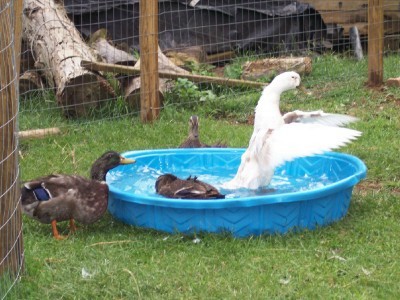 |
| Rouens and Anconas enjoying the pool Then they do something that I call "crack duck". It is better then TV, I swear! They fall out of the pool, often flat on their faces and then run around in circles with their wings out. They fall over some more, run into and over each other and in general look like a feathered version of the Keystone Cops. They act like ducks on crack! Actually, they are just ducks high on one of the simple joys of a duck's life-water! |
Monday, February 7, 2011
Lambing
 |
| Cody, ewes and lambs and Buff Geese napping in front of the old outhouse |
 |
| Fiona and her ram lamb |
Red, an older Katahdin ewe, was the first to go with two ram lambs. Fiona, a first timer, was next with the beautifully marked red and white ram lamb that is at the top of the page.
 |
| Red and her two ram lambs |
 |
| Honey and her newborn ram lambs |
 |
| Patches |
Last will be Reba. Reba is a diva and a lunatic for the most part. She is absolutely beautiful and each time I go in the pasture, she looks at me like I have snakes on my head and departs for another part of the farm! Last year she dropped her lamb and disappeared, leaving me to bottle raise the baby. I am giving her one more chance to redeem herself and care for this years' lambs or it will be lamb chops for her! Good looks will only get you so far!
Saturday, January 22, 2011
Hollywood and Dallas at the Rabbit Show
After feeding everyone this morning, I loaded up Hollywood and Dallas and a Bourbon Red turkey that I had sold, and headed to the rabbit show.
There were hundreds of rabbits at the show, from tiny dwarves to the huge Flemish Giants to the Angoras who look like cotton balls with eyes. Everyone has their favorite breed or breeds. The people and judges are so nice and everything is very laid back. For the most part, you have prepared your rabbits before the show, so once you are there, it is mainly a matter of listening to make sure that you don't miss your class.
Dallas is young for his age group and is also really a breeding stock quality rabbit so he did not place at all. The judges did like his short body and build, but his head is a little long and his crown is a little narrow.
Hollywood's classes only had two rabbits, including him and the other rabbit was older and nicer. The judges did like Hollywood's shoulders and haunches and felt he would improve with age. He was also losing his baby coat and while the hair was not flying loose, his color was patchy.
No rabbit is perfect, so the you take what you learn and try to use that knowledge to improve your herd. So the best doe to breed to Dallas will have good head and crown. Dallas is currently bred to three different does, all a little different and all with different strengthes and weaknesses.
 |
| Narrow Gate Farm Flower, senior Chinchilla Holland Lop doe |
One of the does that he is bred to is Flower. She is a little bit older and probably will not have as many kits as a young doe, but I think that she will be a good cross with him.
 |
| Narrow Gate Farm Diva, Broken Tortoiseshell, Holland Lop doe I bred Diva to Dallas and will have to see if that cross produces any keepers. Neither has a good crown, so breeding them together could compound the problem. Some people do not breed two brokens because they will produce what are called "Charlies" (after Charlie Chaplin). Charlies are broken patterned rabbits that are minimally marked ( but they usually have a little colored moustache). They are quite beautiful but if they have too little color, then they may not be showable. Charlie's do have a place in a breeding program in that when a Charlie is bred to a solid colored rabbit, the resulting offspring will all be broken patterned (no solids). Sort of like breeding a homozygous pinto horse. However, for that to work, the rabbit has to be a Charlie genetically as well as having the phenotype. Some rabbits can look like Charlies but their genotype is that of a broken patterned rabbit.  Campo's Twilla, Blue Tort Senior doe Twilla brings in the dilute blue color, so I am excited to see what her kits look like.  Hollywood doesn't have a girlfriend yet, but I am keeping an eye out fo a doe that will compliment him. The boys were glad to be back home this afternoon and back in their own cages. They were both asleep last time I checked on them. Showing is hard work! |
Subscribe to:
Posts (Atom)