Tuesday, March 15, 2011

No More Fat, White Birds on this Farm!

Tonight I am driving to Asheville for the third class in a series on Heritage Poultry.  The classes are being taught by Jim Adkins, a poultry judge, breeder and owner of the International Center for Poultry.  Jim raises over 50 standard bred varieties of Heritage chickens, ducks, turkeys and geese.  Being in Jim's classes has pushed me over an edge that I had been teetering on for the past year.

 I have raised poultry for over 12 years now.  Most have been Heritage breeds such as Anconas, Speckeled Sussex, Barred Rocks, and Silver Laced Wyandottes, to name a few.  These were my layers and I have become more committed to these breeds the longer I have farmed.  Some of the spare roosters of these breeds were processed for meat but the 400-600 meat birds that I grew out every year were Cornish Rock crosses, those huge , white chickens that the modern poultry industry grows.  I grew mine slowly on pasture and had actually found a strain that had no leg probelms or problems with flip over.  They got right out there and foraged with the Heritage birds. I have some hens that are acturally laying and really, these birds are not "manufactured" to live that long!


The meat from Cornish x birds  raised on pasture is much better then that produced by industrial farming methods and the birds certainly seem happy running all over the farm, but I still did not feel good about raising such a genetically modified bird.  My customers loved the chicken and that also made the switch more difficult.

Then I worked with AWA to have the farm Animal Welfare Approved and I really started to think about the sustainability of buying these birds and having them shipped.  I really wanted to raise my own chicks and grow them out.  Cornish Rocks will not survive long enough to reproduce and they would not reproduce their own kind because they are an F13 cross (thirteen generation cross to achieve these fast growing birds).  I also found out that even the Freedom Ranger, red ranger and Poulet Rouge  birds sold to many small farmers are an F7 cross, they will not reproduce true either.


And lastly, there is taste and texture.  The taste of a properly prepared, Heritage chicken (or duck or goose or turkey) cannot be beat.  The taste is like chicken times ten.  Broth made from these birds is rich and silky and a meal all by itself.  The catch is, just like grass-fed beef (TRUE grass-fed, not the  fed- grain= while- on- pasture kind), these birds have to be cooked longer and at lower temperatures.  So there will be a learning curve for our customers, but I believe that it will be worth it.


So the last of the Cornish will be processed and I am looking forward to a pasture full of old , Heritage breeds that have been hatched  on the farm and grown on the farm.  I will be working with the International Center for Poultry and with AWA to set up a Heritage breeding and hatching operation.  On Saturday, I will head back to Asheville for a Heriatage poultry cooking workshop with Chef Steve Pope from Good Shepherd Poultry Ranch.  Chef Pope cooks only with Heriateg poultry and I am excited to see, and TASTE, his creations with these wonderful birds!

Saturday, March 5, 2011

Rain, Sweet Rain!

I just drug myself in from outside, sopping wet, tired and happy.  I spent the last light of day over seeding the front pasture-by hand.  No tractor, no seeder, no drill-just walking and seeding and filling in the occassional rooted up pig spot.  I had to wait until nearly dusk when the chickens had gone in to roost so they would not follow behind me picking up seed! 

 Fred, my donkey jack, walked with me the whole way.  He knew that I had a sack (treats come in those some times) and that I was scattering something on the ground but he just could not quite figure out what.  He trailed along behind me with his nose on the ground like a bloodhound, trying to find the "treats" that he was sure I was throwing out!


I don't like to put out seed, but these pastures have been so mismanaged and they need help and fast. I overseeded with annual rye, birdsfoot trefoil ( a non-bloat causing legume), red clover and white clover.  The pastures are all fescue now with just a little orchard grass in the one that used to be harvested for hay.

The pastures are overgrazed and have not been limed in years. The previous owner used chemical fertilizers on the hay field (only) and no nitrogen source at all on the rest of the pastures.  The soil is red clay with very little organic matter.

 Last summer, I was able to have the pastures sit empty to rest for a couple of months while I moved the farm.  Once I got the animals moved, I rotated them through the three large pastures, giving each one a few weeks to recover before being grazed again.  The pastures came back quickly and actually started to look fairly decent.


I also was able to move the mobile layer house around the pastures and the chickens added their own, all natural fertilizer to the soil.  Maybe this year, we'll have some earthworms move in!

This year I am dividing the pastures into smaller sections so that I can rotate the animals through quicker and give each section a longer rest period (and break up the parasite life cycles).

For now, I am listening to the rain on the roof, happy that my little seeds are out there getting a good soaking!


Sunday, February 27, 2011

Let's Throw Some Pots-in the Garden

My friend, Barabara, and I make pottery together every now and then.  She is the pottress (the clay kind) and I sculpt and paint and decorate.  She said that if I ever learned how to "throw" clay, then I would no longer need her-so I never learned!  North Carolina is home to Seagrove, a community of potters, and pottresses, and clay dug right out of the ground.

North Carolina is also home to another sort of clay that many of us curse.  Red clay.  Yes, I believe that you could sculpt with it, but I don't like it in my gardens, which is, of course, right where it is.  I have lived in NC all of my life and been lucky to have never encountered this boot sucking, ankle wrenching stuff on any of the properties where I lived.  Well, now I have plenty of it.  In the garden, in the pastures and in the flower beds.


I moved to this particular farm in July 2010.  For the last several years, chemical fertilizers and herbicides have been used on the farm.  The pastures were over grazed and no lime has been spread.  The results?  Lots of broom sedge in the pastures, sparse grass (dirt showing), hard clay with no organic matter, and not an earthworm in sight.

A pretty picture except for the broom sedge
The first mistake-I decided to let some new baby pigs root around the garden.  They were small and I was afraid that they would scoot under my electric fence (and into the neighbor's perfectly manicured lawn=disaster).   So I fenced them onto the garden and moved them once a week. 

These little piggies happily tilled up the garden, eating grubs, grass and roots and fertilizing along the way.  So far so good. 

Second Mistake-The damage came when I moved the pigs to a new area.  I used to throw corn on the turned over the dug up pig piles and the chickens would scratch and smooth it all out again.  Works great with fine, friable mountain soil.  The baby ducks and fat Cornish Rock chickens trampled over the newly turned clay with their big, flat feet and soon made a impenetrable hard pack out of every area the pigs had turned over.   Lesson learned, keep foot traffic, mine and theirs, off of the red clay as much as possible.

The Solution (I hope)- The pigs are coming off and the chickens are coming out.  The chickens are fenced on some grassy areas ( no soil showing) that I will plant later in corn, pumpkins, beans and tomatoes.  I plan to till these areas as little as possible and to plant a "smother crop" of Dutch White Clover.  A smother crop is achieved by heavily over seeding  an area with a crop, in this case , the clover.


The clover will accomplish several objectives.  First, it will protect the soil where I walk through the rows of vegetables from becoming too compacted.  Second,  it should smother out most of the grasses and weeds and the area should not have to be mown very often (Dutch White Clover is not very tall).  Third, and best, clover is a legume and legumes add large amounts of all natural nitrogen and organic matter to the soil-which is what this soil desperately needs.

Turning abused land back into productive land takes time and patience.  It takes a lot less time to deplete a piece of land then it does to repair it.  I will keep adding updates and photos of the pastures and gardens as they progress.  Now to get those pigs moved....

Tuesday, February 8, 2011

Crack Ducks

Rare Ancona ducklings
Khaki Campbells, egg laying ducks

I took advantage of the warmth and sunshine and tried to get as much done outside today as possible.  I vaccinated the new lambs and kids, gave the rabbit colony a new bed of straw, picked up and unloaded 800 lbs of feed, cleaned the milk room in preparation to start milking the goats again, bred the show rabbits and unburied my desk (Ok , that was inside).  Now, I should be in bed, but I have my second (third, fourth???) wind and am wide awake.  I'll pay in the morning!

I did stop long enough today to "play" with the ducks.  I love ducks.  They are cute and funny. They make me laugh and smile no matter what kind of mood I am in.  And they are easy to please.  You can absolutely make a duck's day with just a hose and a pan of water.


Note the rooster in the top right trying to squeeze in for a drink
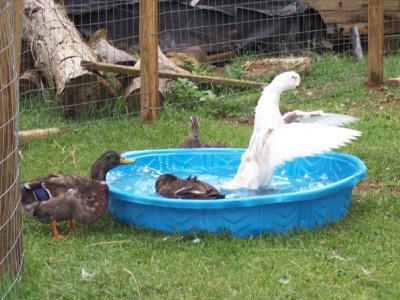
 How many Khaki Campbells fit in a tub-seven to be exact-with no room for more.  These young Khakis are playing in their "kiddie pool", the bottom of an old rabbit cage which is shallow enough for the babies to get in and out of.  Ducks love water at any time but they seem to derive particular pleasure out of fresh, clean water and a shower from the hose.  They splash and flail and quack (well, the females quack, males are silent-hhhmmm).

Taking a rest after their bath

A chocolate Ancona, a black Ancona and a Pekin

Rouens and Anconas enjoying the pool

Then they do something that I call "crack duck".  It is better then TV, I swear!  They fall out of the pool, often flat on their faces and then run around in circles with their wings out.  They fall over some more, run into and over each other and in general look like a feathered version of the Keystone Cops.  They act like ducks on crack! Actually, they are just ducks high on one of the simple joys of a duck's life-water!


Monday, February 7, 2011

Lambing

Cody, ewes and lambs and Buff Geese napping in front of the old outhouse
The lambs and kids have started arriving with 7 being born over the course of two days.  Seven boys!  Yes, ALL of them are boys! 

Fiona and her ram lamb

Red, an older Katahdin ewe, was the first to go with two ram lambs.  Fiona, a first timer, was next with the beautifully marked red and white ram lamb that is at the top of the page.
Red and her two ram lambs

Honey and her newborn ram lambs
Honey waited until the next day, which was sunny and warm to have her two boys out in the pasture in the sun.  I never lock the sheep and goats up.  They are free to lamb/kid in the open fronted barn or in the pasture.  The sheep will always choose the pasture unless the weather is wet and the goats almost always choose the barn.


Patches
My best two ewes, Sadie Mae and Patches, are waddling around the pasture-HAVE been waddling around for a week- and still no lambs.  They are both huge and I am hoping for at least one ewe lamb from each of them.  Patches' two year old ewe, Tulip, is also still due.  Tulip is a nice Dorper cross ewe.  This will be her first lambing, so I only expect one lamb from her. 

 Last will be Reba.  Reba is a diva and a lunatic for the most part.  She is absolutely beautiful and each time I go in the pasture, she looks at me like I have snakes on my head and departs for another part of the farm! Last year she dropped her lamb and disappeared, leaving me to bottle raise the baby.  I am giving her one more chance to redeem herself and care for this years' lambs or it will be lamb chops for her!  Good looks will only get you so far!


Saturday, January 22, 2011

Hollywood and Dallas at the Rabbit Show

After feeding everyone this morning, I loaded up Hollywood and Dallas and a Bourbon Red turkey that I had sold, and headed to the rabbit show.

There were hundreds of rabbits at the show, from tiny dwarves to the huge Flemish Giants to the Angoras who look like cotton balls with eyes.  Everyone has their favorite breed or breeds.  The people and judges are so nice and everything is very laid back.  For the most part, you have prepared your rabbits before the show, so once you are there, it is mainly a matter of listening to make sure that you don't miss your class. 

Dallas is young for his age group and is also really a breeding stock quality rabbit so he did not place at all.  The judges did like his short body and build, but his head is a little long and his crown is a little narrow. 
Hollywood's classes only had two rabbits, including him and the other rabbit was older and nicer.  The judges did like Hollywood's shoulders and haunches and felt he would improve with age.  He was also losing his baby coat and while the hair was not flying loose, his color was patchy.

No rabbit is perfect, so the you take what you learn and try to use that knowledge to improve your herd.  So the best doe to breed to Dallas will have good head and crown.  Dallas is currently bred to three different does, all a little different and all with different strengthes and weaknesses.

Narrow Gate Farm Flower, senior Chinchilla Holland Lop doe
One of the does that he is bred to is Flower. She is a little bit older and probably will not have as many kits as a young doe, but I think that she will be a good cross with him. 


Narrow Gate Farm Diva, Broken Tortoiseshell, Holland Lop doe

I bred Diva to Dallas and will have to see if that cross produces any keepers.  Neither has a good crown, so breeding them together could compound the problem.  Some people do not breed two brokens because they will produce what are called "Charlies" (after Charlie Chaplin).  Charlies are broken patterned rabbits that are minimally marked ( but they usually have a little colored moustache).  They are quite beautiful but if they have too little color, then they may not be showable.  Charlie's do have a place in a breeding program in that when a Charlie is bred to a solid colored rabbit, the resulting offspring will all be broken patterned (no solids).  Sort of like breeding a homozygous pinto horse.  However, for that to work, the rabbit has to be a Charlie genetically as well as having the phenotype.  Some rabbits can look like Charlies but their genotype is that of a broken patterned rabbit.


Campo's Twilla, Blue Tort Senior doe

Twilla brings in the dilute blue color, so I am excited to see what her kits look like.

Hollywood, broken Chinchilla junior Mini Lop buck

Hollywood doesn't have a girlfriend yet, but I am keeping an eye out fo a doe that will compliment him. The boys were glad to be back home this afternoon and back in their own cages.  They were both asleep last time I checked on them.  Showing is hard work!


Friday, January 21, 2011

Showing Rabbits

Chores seemed to take a long time today or could it be that I am just getting older and slower???  Nah!

I was enjoying the sunshine and warmer temps for sure.  I gave all of the pigs big mounds of hay and they are all out sleeping in the sun right now.  Full bellies + sunshine + a comfy bed= happy pigs!


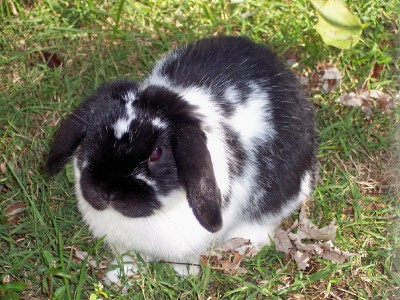
Narrow Gate Farm Dallas-broken black Holland Lop buck

I have been wanting a chance to photograph some of the rabbits and today is a perfect day for that too.  Hollywood will be a bit of a challenge since he has no fear of jumping off anything from any height.  He can be a bit of a pill, but he is new here and still figuring everything out.


Musical Bunnies Hollywood-Broken Chinchilla Mini Lop buck


Right now Hollywood is playing in my office floor-leaping and bucking and conducting solitary rabbit races around my Pyreness (who is oblivious).  Basically I am trying to get the "ants out of his pants" before going outside for our photo shoot!  Dallas will have his turn next.  He loves to get let out to play.

Tomorrow I am taking a break from the farmer's markets to go to a rabbit show.  I am taking a couple of the young boys to see how they do.  I still have a lot to learn and these are not top quality show rabbits but I am interested to see what the judges say about them.  It is all a learning experience and everything that I learn will help me to improve my herd.

Dallas
I have always loved rabbits and at different times, there have been house rabbits and yard rabbits and even pasture rabbits.  I like the lop earred rabbits although I always think of the words of a prominant tan breeder who says that they "look like puppies and that he likes rabbits that look like rabbits".  They do have a puppy dog look and they are so cute.  I also love anything spotted, so I have several "brokens" and some dilutes, which are my favorites.

In preparation for the show, I have had the boys out clipping nails, brushing them, posing them and just basically handling them and reminding them what it is like to be picked up and posed and moved around.  At a rabbit show, when your class is called, you place your rabbits in  a "coop" (one of a long row of small cages) in front of the judge.  The judge then takes the rabbits out one by one and handles them.  You cannot really tell the body type of a rabbit until you put your hands on it.  Once you hold them, you can feel the thickness of the shoulders, their body condition, fur condition etc.  The judge then moves the rabbits around in the coops with the higher placings going to one end and the others going to the opposite end. 

The most beneficial part of a rabbit show for a breeder is that after the judge has sorted out the rabbits, he/she will then comment on their reasons for each placement.  The judge's comments (as well as the placing in the show) are a tool for helping to evaluate your rabbits.  Rabbit shows are also attended by people who like rabbits (they are like potatoechips, you can't have just one) and buy them.  The shows get your rabbits out in front of people who like your breed and who may buy from you.

I have three Holland Lop does bred and set to kindle at the end of January.  The does are all different with different strengths and weaknesses.  Any kits with disqualifications or obvious faults will be sold as pets without pedigrees.  I will keep the rest of the offspring until they are about 3-4 months old.  At that time, I will choose one or two of the best ones to keep and show. 


Narrow Gate Farm Diva, Broken Tortoise Holland Lop doe

When you purchase rabbits, no breeder is going to give you his absolute best stock, so you usually purchase the best that you can and then improve your herd through breeding and culling.  Rabbits have a quick turnaround, so a herd could be improved quite quickly with judicious culling.  By culling in the case of a pet and fanciers breed (as opposed to a meat breed), I mean that the rabbits not kept in my barn for showing/breeding will be sold as pets and as brood stock (not eaten).

Hollywood
Although it would be fun to place well tomorrow, the best win for me will be from rabbits that I have bred myself.  I think that Mike and Joanna could attest to that as far as goats go!  The two rabbits going tomorrow are from local breeders.

Meat rabbit brood does, fertilizing the garden to be-a New Zealand and a NZ/Californian cross

I have a different criteria for culling meat rabbits and those culls do usually go on someones table.  With the meat rabbits, I weigh litters and actually keep track of how many pounds of rabbit each doe produces per year.  I keep my replacement breeding stock from does who wean large litters with heavy weaning weights.  This means that they are good moms who produce a lot of milk.  The New Zealands and Californians that I currently have are commercial rabbits and are not pedigreed, so I will not show them.  I do hope to add some pedigreed NZ and Cals soon.

Well, off to get the car packed for tomorrow.  More tomorrow on how we did.